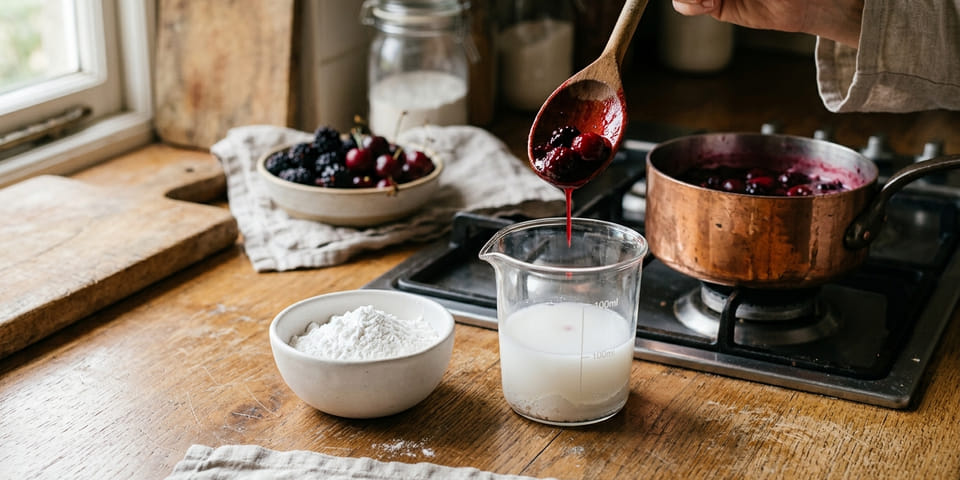
How much thickener are you actually replacing?
Work this out first, because it decides every number below.
About one tablespoon of arrowroot per cup of liquid. Illinois Extension puts cornstarch at “1 tablespoon per 1 cup liquid”, and both Colorado State and Mississippi State price arrowroot level with cornstarch, so the figure carries straight across. That step is ours, but it is one step from two sources that agree.
Flour is the outlier: Illinois puts it at “2 tablespoons per 1 cup liquid” — “it takes twice the amount of flour… to achieve the same results with cornstarch”. That is the single most useful ratio on this page, because flour is what most people actually have.
Cornstarch, 1:1 — and the one argument about it
If you are out of arrowroot, use cornstarch, tablespoon for tablespoon.
Colorado State University Extension lists “Arrowroot, as thickener, 1 Tbsp = 2 Tbsp all-purpose flour, 1 Tbsp cornstarch” — and then lists the swap the other way round too, under cornstarch. A chart that states a substitution in both directions is worth more than one that states it in a single direction, because the reverse is where these charts usually go quiet. Mississippi State agrees: “Arrowroot starch, 1½ tsp = 1 tbsp flour = 1½ tsp cornstarch.”
Now the argument. America’s Test Kitchen put arrowroot through three recipes and came out somewhere else: “Almost 1½ teaspoons of arrowroot thickens the same amount of liquid as 1 teaspoon cornstarch.” That is half again as much arrowroot — the opposite of what the charts say, and it comes from the only source here that reports actually cooking with it.
Does the composition settle it? Not quite, but it narrows the question. USDA measures arrowroot flour at 88.2% carbohydrate and cornstarch at 91.3% — arrowroot carries about 3% less starch by weight. Real, but nowhere near enough to explain a 50% difference in dose. Whatever is going on is about how the two starches behave when they gelatinise, not how much starch is in the bag.
So: start at 1:1. That is what both institutional charts state, and it is the figure this page leads with. If your sauce comes out looser than you expected, you have run into the Test Kitchen’s finding, and adding up to half again is the documented fix rather than a guess.
What is arrowroot?
A nearly pure starch milled from the rhizome of a tropical plant. USDA puts arrowroot flour at 88.2% carbohydrate, 0.3% protein and 0.1% fat — which is what “nearly pure starch” looks like on a nutrition panel, and why it has almost no flavour of its own.
It is not tapioca, and it is not made from cassava. You will see that claim on more than one page currently ranking for this query; cassava is where tapioca comes from. The two are different plants giving different starches, and the extension charts price them differently — arrowroot level with cornstarch, granular tapioca at double it. If they were the same thing the charts would not disagree by a factor of two.
What it is for. Shirley Corriher, a food chemist writing for The Splendid Table, groups arrowroot with tapioca as root starches — up to 99% amylopectin, against 22–27% amylose in grain starches like corn and wheat. Root starches, she writes, “are crystal clear hot or cold”, “freeze and thaw nicely without change” and “thicken at lower temperatures than grain starches.” That combination is why arrowroot turns up in glazes, fruit fillings and clear pan sauces, and why it costs more than cornstarch.
How the starches compare
| Per 100 g (USDA) | Carbohydrate | Protein | Water | Calories |
|---|---|---|---|---|
| Arrowroot flour | 88.2 g | 0.30 g | 11.4 g | 357 |
| Cornstarch | 91.3 g | 0.26 g | 8.3 g | 381 |
| Tapioca, pearl, dry | 88.7 g | 0.19 g | 11.0 g | 358 |
All three are essentially starch and water, and nutritionally they are close enough that the numbers will not help you choose. The choice is about behaviour, and the behaviour differences are large:
- Clarity. Illinois Extension: “A sauce thickened with flour will be cloudy and opaque, while a cornstarch thickened sauce will look transparent and glossy.” Arrowroot goes further. Corriher has grain starches “clear when hot but cloudy when cold” and root starches “crystal clear hot or cold” — so the difference only shows up once the dish cools.
- Freezing. Corriher, on grain starches: they “become spongy and leak watery fluid when frozen and thawed.” Root starches “freeze and thaw nicely without change.”
- Set. The trade-off. Grain starches “set up thick enough to slice with a knife”; root starches “set up in a thick, clear, glossy coating — not firm enough to cut.” For a pie that has to hold a wedge, Corriher says go with flour or cornstarch.
- Dairy. This is the one that will actually catch you out. See below.
- Stirring and heat. Root starches “thin when vigorously stirred, hot or cool”, and are “thickest when hot at their gel temperature.” Add arrowroot at the end, stir it gently, and take the pan off the heat once it thickens.
The dairy problem, which is the real headline
America’s Test Kitchen swapped arrowroot into three recipes. It worked as a coating for General Tso’s chicken — some tasters preferred it to “chalkier” cornstarch — and it made a clearer lemon meringue pie.
In the butterscotch pudding, tasters described it as slimy. Their science editor explained that arrowroot forms a “mucilaginous substance” when combined with liquid, “an effect that may be exaggerated when the liquid is dairy.” Their own conclusion: “save it for translucent sauces and fillings and avoid it in recipes with dairy.”
This matters more than the ratio argument. If your recipe is a pudding, a custard or a cream sauce, the answer is not how much arrowroot to use — it is to use cornstarch instead, and the swap is the easy one at 1:1.
Which one should you use?
Thickening a glaze, or a sauce that has to stay clear once cold? Potato starch, 1:1. It keeps the clarity and gloss you wanted arrowroot for. Colorado State puts arrowroot, cornstarch, potato starch and rice starch on one line against flour, so they are interchangeable at equal measure. America’s Test Kitchen notes it “begins to thicken liquid before it reaches a simmer”, so add it late, as you would arrowroot.
Anything with milk, cream or cheese in it? Cornstarch, 1:1, and do not overthink it. This is the one job arrowroot is bad at.
Making a gravy or a pan sauce? All-purpose flour, but double it — two tablespoons per cup of liquid where arrowroot took one. Cook it out properly or it tastes raw, and accept that the result will be opaque.
Making a fruit pie you plan to freeze? Quick-cooking tapioca at double the arrowroot. Both charts price granular tapioca at two tablespoons per one of cornstarch. Note the charts cover granular and quick-cooking tapioca — not tapioca starch sold as a fine flour, which is a different product they do not price.
Baking rather than thickening? None of these is doing arrowroot’s job in a gluten-free flour blend, where the task is structure rather than viscosity. That is a different problem with different answers — see xanthan gum substitutes, where the useful comparison is between binders rather than starches.
Using arrowroot in place of cornstarch
Running it the other way is the same relationship read backwards, and it is what a lot of people actually want: the arrowroot is in the cupboard and the recipe says cornstarch.
Use the same amount — one tablespoon of arrowroot for one tablespoon of cornstarch, per both charts. Then change three things about how you use it:
- Slurry it in cold liquid first, as America’s Test Kitchen specifies for cornstarch — “mix it with cold liquid to form a slurry before adding the thickener to hot liquids to prevent clumping.”
- Add it near the end of cooking. Arrowroot thickens at a lower temperature than cornstarch and thins again if you hold it at a boil.
- Take the pan off the heat as soon as it thickens. There is no benefit to cooking it longer, and there is a cost.
What you gain: a sauce that is clear and glossy hot and cold, and that freezes and thaws without going spongy. What you give up: it will not set firm enough to cut, so it is the wrong choice for a pie that has to hold a wedge — and it must stay away from dairy.