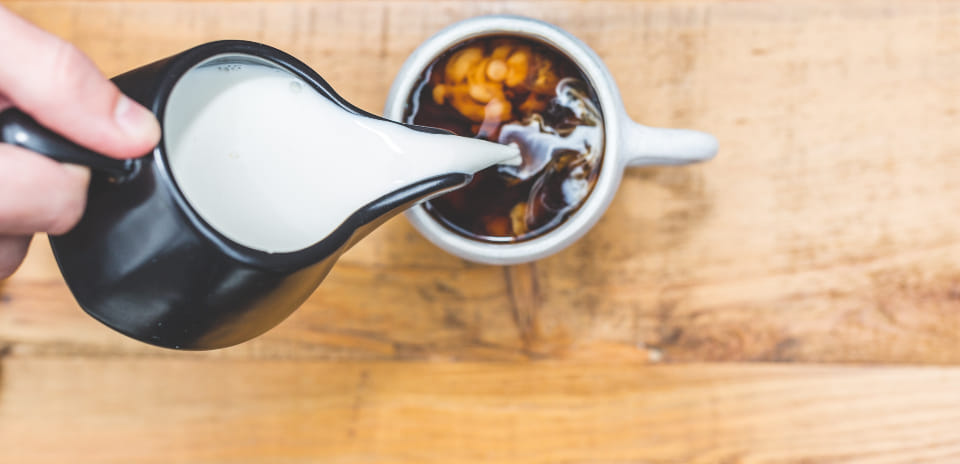
How to make evaporated milk at home
This is the swap to use if you have twenty-five minutes, and it is the only one that matches the can on concentration rather than approximating it.
- Pour 2¼ cups of whole milk into a wide, heavy-bottomed pan. A wide pan matters — more surface area means faster evaporation and less time on the heat.
- Bring it to a bare simmer, then drop the heat so it never boils hard. Boiling scorches milk proteins onto the base of the pan and you will taste it.
- Stir every few minutes and scrape the bottom. Expect 20 to 30 minutes.
- Stop when you are down to 1 cup. Pour it into a measuring jug to check rather than eyeballing it in the pan.
- Cool it before it goes anywhere near eggs or sugar, or you will scramble them.
That gives you one cup of evaporated milk. Need a full 12 fl oz can? Start with 3⅜ cups and reduce to 1½ cups.
One thing the can does that your pan does not: the FDA standard requires evaporated milk to be “sealed in a container and so processed by heat, either before or after sealing, as to prevent spoilage.” Yours has not been. Refrigerate it and use it within a few days, exactly as you would fresh milk.
Why 2¼ cups, and not 2 or 2½
You will find three different ratios quoted online, and they are not random — each one is measuring something different. This is worth ninety seconds, because it decides whether your pie sets.
- 1½ cups → 1 cup. Missouri Extension’s number. It gets you a thicker milk, but it lands well short of the canned product.
- 2 cups → 1 cup. This is what the FDA minimums imply. Evaporated milk must carry at least 23% total milk solids; milk must carry at least 3.25% milkfat and 8.25% milk solids not fat, which totals 11.5%. Double 11.5 and you get 23 — the legal floor, exactly. Nothing wrong with it, but a floor is not a target.
- 2¼ cups → 1 cup. What the real product measures. USDA puts canned evaporated milk at 74.0 g of water per 100 g — 26.0% total solids — and whole milk at 88.1 g water, or 11.9% solids. That is a 2.19× concentration by weight, and because evaporated milk is the denser liquid, the cup-for-cup ratio sits a little above that again.
So: 2¼ cups is the honest answer. Two cups still clears the legal definition and will not ruin anything. Below two cups, you are making thick milk, not evaporated milk — fine in a soup, not fine in a custard.
The same arithmetic explains the “60% of the water removed” line you see everywhere. Take milk at 88.1% water, remove 60% of that water, and you are left with a liquid that is roughly 75% water. USDA measures the can at 74.0%. The two descriptions agree.
What is evaporated milk?
Milk with about half the water simmered out of it, sealed in a can and heat-treated so it keeps in the cupboard. The FDA defines it as “the liquid food obtained by partial removal of water only from milk” — only water. Nothing is added except vitamin D, which the standard requires, and vitamin A, which is optional.
It is unsweetened. If you have seen it called unsweetened condensed milk, that is the same thing; sweetened condensed milk is a separate FDA standard with sugar in it.
What it does in a recipe is concentrate. Twice the milk solids in the same volume of liquid means more protein to set a custard, more lactose to brown, and more body in a sauce — without the fat load of cream. That is why it turns up in pumpkin pie, fudge, mac and cheese, tres leches and evaporated-milk-based coffee.
How the substitutes compare
Every number below is USDA measured composition per 100 g. Fat tells you how rich the result will be; protein tells you whether it will set.
| Per 100 g | Water | Total solids | Fat | Protein | Calories |
|---|---|---|---|---|---|
| Evaporated milk | 74.0 g | 26.0% | 7.6 g | 6.8 g | 134 |
| Whole milk (3.25%) | 88.1 g | 11.9% | 3.3 g | 3.2 g | 61 |
| Half-and-half | 80.6 g | 19.4% | 11.5 g | 3.1 g | — |
| Heavy whipping cream | 57.7 g | 42.3% | 36.1 g | 2.8 g | — |
| Canned coconut milk | 72.9 g | 27.1% | 21.3 g | 2.0 g | — |
Read the protein column and the whole page falls into place:
- Half-and-half has more fat than evaporated milk but 46% of the protein. It pours and tastes right in a sauce. In a pie filling it sets softer.
- Heavy cream is nearly five times the fat and under half the protein. Cutting it 1:1 with water brings it to roughly 18% fat and 21% solids — much closer to the can, and it lands in the 18–20% light-cream band that Mississippi State, Missouri and North Dakota State extension services all treat as interchangeable with undiluted evaporated milk in cooking.
- Canned coconut milk is the surprise. On total solids it is a near-exact match — 27.1% against 26.0% — which is why it thickens convincingly. But it carries nearly three times the fat and under a third of the protein.
One correction worth making plainly, because it is repeated widely and it is wrong: evaporated milk does not sit in the 18–20% milkfat band. USDA measures it at 7.6%. When the extension charts say a cup of undiluted evaporated milk replaces a cup of light cream, they are describing how the two behave in a finished dish, not claiming they have the same fat content.
Which one should you use?
Making a pumpkin pie, flan, cheesecake or any custard that has to set? Reduce the milk. Nothing else on this list carries evaporated milk’s protein, and protein is what turns a liquid filling into a sliceable one. If you are stuck, half-and-half is the least bad alternative — expect a softer set and a slightly longer bake.
Making a sauce, soup, mac and cheese or creamy pasta? Half-and-half, straight, 1:1. Missouri Extension lists it directly as a substitute for evaporated milk, and nothing in a sauce depends on the extra protein.
Making fudge or caramel? Reduce the milk. Sugar work is unforgiving about water content, and this is the one option that gets the water right.
Only have cream? Cut it 1:1 with water first. Neat heavy cream will work, but it will make the dish heavier than the recipe intended.
Nothing fresh in the house? Nonfat dry milk. North Dakota State Extension gives one cup of powder whisked smooth into 1¾ cups of warm water for a 12 fl oz can. There is no milkfat in it at all, so stir in a tablespoon of butter if the recipe is relying on richness.
Dairy-free and lactose-free options
Evaporated milk is neither. It is milk with water removed, so the lactose is not only still there, it is concentrated. Two routes work:
Full-fat canned coconut milk, 1:1. The straightforward swap. USDA puts it at 27.1% total solids against evaporated milk’s 26.0%, so it thickens almost identically — this is why it holds up in curries and coconut-friendly desserts. Two caveats, both real: it carries roughly three times the fat, and under a third of the protein, so it will not set a custard the way the can does. And it tastes of coconut. In a pumpkin pie that reads as a deliberate choice; in a savoury gratin it reads as a mistake.
Reduce a plant milk yourself, 2¼ cups → 1 cup. Same method as the dairy version. Unsweetened soy holds together best because it actually has protein in it; oat reduces well and stays neutral; almond and rice are thin and will not give you much body. Watch it more carefully than dairy milk — plant milks catch and scorch faster.
We are not going to quote you a precise ratio for the plant-milk route, because we have not found a source we trust that gives one. The 2¼-to-1 figure is the dairy ratio applied by analogy. It is a sound starting point, not a measured equivalence.
How much is in a can?
The standard US can is 12 fl oz, which is 1½ cups. The small can is 5 fl oz, or ⅝ cup — a little over half. North Dakota State Extension’s chart uses the 12 fl oz can as its reference unit; older charts, including Mississippi State’s, still refer to a 13 oz can.
So if the recipe says one can:
- 12 fl oz can → 1½ cups of any 1:1 substitute, or 3⅜ cups of whole milk reduced to 1½ cups
- 5 fl oz can → ⅝ cup of any 1:1 substitute, or 1⅜ cups of whole milk reduced to ⅝ cup
And running it the other way: a 12 fl oz can diluted with an equal volume of water gives you 3 cups of ordinary milk.